Introduction
John C. Depp, II v. Amber Laura Heard (CL-2019-2911) was a civil defamation trial which took place in Fairfax County, Virginia from April 11th to June 1st, 2022. Every moment of the trial was live streamed on YouTube, attracting millions of viewers and garnering unprecedented amounts of social media commentary across many platforms. American actor Johnny Depp, the plaintiff, alleged three counts of defamation against his fellow actor and ex-wife, defendant Amber Heard. His claim was for $50 million in damages; Heard filed counterclaims against Depp with a claim for $100 million in damages. These numbers would be ludicrous in the context of an average civil dispute, but given the celebrity status of both the plaintiff and the defendant, the case was catapulted to the level of international social media spectacle. According to a content analysis conducted by journalists at Axios in May 2022, the trial amassed more online attention than some of the country’s biggest and most pressing news stories, including the leaked Supreme Court decision to overturn Roe v. Wade and Russia’s war in Ukraine. To quote the authors, “courtroom dramas, especially those featuring celebrities, have long been a staple of the American media appetite, but this one stands out as the first major trial to go viral in the TikTok era” (Fischer & Rothschild, “America More Interested in Depp-Heard Trial than Abortion”). The vast majority of the commentary on social media was in support of Depp, with the hashtag #JusticeForJohnnyDepp spreading across all platforms. At the same time, online hatred and mockery towards Heard among Depp fans proliferated, including hashtags such as #AmberHeardIsALiar and #AmberHeardIsAnAbuser. By exploring both the explicit and implicit meaning of the aforementioned hashtags, it is possible to dissect the overarching social messages and themes among the discourse.
This paper will critically analyze the media response to semiotic use and meaning of the hashtag #JusticeForJohnnyDepp across social media platforms. The study of discourse on social media is particularly important given the ubiquity of Internet communication and social networking websites. In their 2014 paper “Hoes and hashtags: constructions of gender and race in trending topics,” Rightler-McDaniels and Hendrickson elaborate on the ways in which “social networking and micro-blogging websites, specifically Twitter, offer users a computer-mediated social setting to exchange an array of discursive dialogue, whereby social meaning within communication production can elaborate undisturbed” (175). The methodology of this study will center around the theories of Critical Discourse Analysis by Teun van Dijk; particularly his work Society and Discourse: How Social Contexts Influence Text and Talk (2009). In order to understand the discourse surrounding Depp v. Heard, it is crucial to unpack the context in which these hashtags are used. In the words of van Dijk, “the relation between society and discourse is indirect, and mediated by the socially based but subjective definitions of the communicative situation as they are construed and dynamically updated by the participants” (vii). It is these subjective definitions mentioned by van Dijk which will form the centerpoint of this analysis, and in particular, how these two hashtags represent broader cultural attitudes towards power, celebrities, gender roles, and justice. This exploration will begin with a summary of the events leading up to Depp v. Heard, followed by examples of social media posts containing the hashtag #JusticeForJohnnyDepp. Finally, the author will discuss the social and cultural context in which this hashtag is used, building upon van Dijk’s “theory of discourse, interaction, and communication,” (1).
Background: Timeline of the Trial
The actors, who married in February 2015, divorced after Heard claimed in May 2016 that Depp had abused her physically, which he denied. In a separate libel case in April 2018, Depp sued a British tabloid after it labeled him online as a “wife beater.” Depp lost at trial in November 2020 with the presiding judge ruling that “the great majority of alleged assaults of Ms Heard by Mr Depp have been proved to the civil standard.” Several legal experts suggested that Depp had a smaller chance of winning in the US trial compared to the UK trial (Syal 2022; Levinson-King 2022). The Virginia trial centered on a December 2018 op-ed by Heard, published in The Washington Post, in which she stated that she had spoken up against “sexual violence” and become “a public figure representing domestic abuse.” Depp’s complaint of defamation blamed Heard’s op-ed for damaging his reputation and career and causing him extensive financial loss. Heard’s counterclaims included allegations that a lawyer of Depp’s had defamed her in statements published in the Daily Mail in 2020. Throughout the trial, Depp’s legal team sought to disprove Heard’s abuse allegations and to demonstrate that she had been the instigator, rather than the victim, of intimate partner violence. Heard’s lawyers defended the op-ed, claiming it was factual and protected by the First Amendment.
On June 1, the jury ruled that Heard’s op-ed references to “sexual violence” and “domestic abuse” were false and defamed Depp with actual malice, awarding him $10 million in compensatory damages and $5 million in punitive damages from Heard, although the court reduced the punitive damages to $350,000 due to a limit imposed by Virginia state law. The jury also ruled that Waldman (Depp’s lawyer) had defamed Heard by falsely alleging that she and her friends “roughed up” Depp’s penthouse as part of a “hoax.” The jury awarded Heard $2 million in compensatory damages and zero in punitive damages from Depp. Separately, the jury ruled that Waldman’s other allegations of Heard’s “sexual violence hoax” and “abuse hoax” against Depp had not been proven to be defamatory.
Social Media Response and Social Context
Investigations by several different journalists across various media platforms have commented on the powerful and polarized wave of social media response to the trial. In 2016, when the legal battle between Depp and Heard was just beginning, Heard had significantly more online support than Depp. Her allegations against Depp coincided with the rise of the #MeToo movement, wherein women in the entertainment industry were encouraged and empowered to speak out against sexual violence, specifically by powerful men. As the #MeToo movement gained momentum, the consequences for men in Hollywood who were accused of sexual assault became increasingly dire. Just a few notable examples of powerful men in the entertainment industry who faced these career-ending consequences (colloquially known as being “canceled”) include film producer Harvey Weinstein, actor Kevin Spacey, and musician R. Kelly. When Heard first accused Depp of domestic violence, he joined an ever-growing list of men in Hollywood who have been accused of such behavior. However, as Depp pursued legal action against Heard and details of the case became public, support for the actor began to grow, and the hashtag #JusticeForJohnnyDepp emerged. Although Depp lost his libel case against The Sun in the United Kingdom, his online support gained even more momentum in anticipation of the Depp v. Heard trial in the United States.
The media access to the courtroom via live stream gave the public an intimate and sometimes unhinged glimpse into Depp and Heard’s relationship. Witness testimony on behalf of the plaintiff and the defendant, as well as testimony from Depp and Heard themselves, came under the ruthless microscope of public scrutiny. Social media provided a virtual and global medium for sharing and discussing details of the case, and spectators around the world became a court of public opinion free from any regulation or protocol present within the actual court. The jury, according to the American justice system, must hear all the details of the case before rendering a verdict, but the public is under no such obligation. In this case, the hashtag #JusticeForJohnnyDepp came to represent the growing public discourse that Depp was innocent of any wrongdoing, and Heard’s allegations were lies worthy of punishment. At the same time, there remained on social media a less dominant (but no-less convinced) discourse in support of Heard, citing the tenets of the #MeToo movement and the insidious influence of misogyny.
Journalist Amelia Tait of The Guardian said that Heard v. Depp had turned into “trial by TikTok,” enumerating on the ways in which the case had become “a source of comedy” on social media. Similar themes were noted by journalists at BuzzFeed News, The Independent, and Vanity Fair. Amanda Hess, a critic writing for The New York Times, stated that the broadcasting of the trial “is an invitation for the proceedings to be deliberately, even gleefully tailored to a viewer’s whim,” with Internet platforms like TikTok and YouTube being “practically built to manipulate raw visual materials in the service of a personality cult, harassment campaign or branding opportunity.” Shannon Keating, a culture writer and editor for BuzzFeed News, wrote that the “social media frenzy around this case was clearly fueled by savvy PR bots, and conservative media advertising, with the result that lots of people have happily accepted the propaganda as sacrosanct.” The discourse on the trial and social media commentary by way of hashtags has made it clear that the Depp v. Heard trial is, in the words of Tait, “actually two cases: one decided by the jury in the court of law, and another by the people in the court of public opinion.” In an interview with Forbes, a professional in the Public Relations industry said that “of course it would be a great plus for [Depp’s] campaign if his version is the true version of things,” but the truth, of course, can be tricky or impossible to define. “At the end of the day, what a great PR agency does is to try to shape perception,” the expert continued; “perception of truth is more powerful than the truth itself, and with the variety of opinions and backgrounds in the public square, it is almost certain that you would find a base willing to give your client a chance to exist and thrive” (Wilson, “Optics and Facts; What the Johnny Depp and Amber Heard Trial Teaches Us about the Power of Pr.”).
In an interview with NPR, sociologist Nicole Bedera, who specializes in domestic violence, spoke about “the trial and its implications for discussions about intimate partner violence — and why social media seems to have far more sympathy for the former Pirates of the Caribbean star than for his ex-wife” (Tsioulcas and Rascoe, “On Social Media, Johnny Depp Is Winning Public Sympathy over Amber Heard.”) Bedera goes on to say, “we all think that sexual violence is wrong and say that we will believe and support survivors, up until the perpetrator is someone we know and like. You don’t want to feel like you’re a bad person if you continue to like Pirates Of The Caribbean.”
Examples of Social Media Posts with #JusticeForJohnnyDepp
For the purpose of this study, the author conducted a search on Twitter of posts with more than 1,000 “likes” containing the hashtag #JusticeForJohnnyDepp. Upon initial review, it becomes clear that the posts with the most engagement contain not just words, but images as well. Each example will be accompanied by a brief description of the messages within the tweet. Following these examples, the author will discuss the overarching discursive themes according to Van Dijk’s theory of mental models and cultural context models.
Example #1
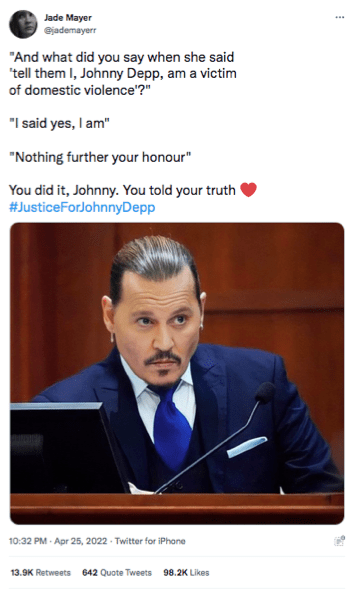
This tweet posted by Twitter user @jademayerr on April 25, 2022, currently has nearly 14 thousand “retweets” (meaning other users re-posted the tweet to their own feed and followers) and more than 98 thousand “likes.” The body of the text contains quotes from the trial, wherein Depp says that he is a victim of domestic violence. The quote is followed by a message of support for Depp, saying “You did it, Johnny. You told your truth” followed by a red heart Emoji. The image accompanying the words shows Depp sitting on the witness stand as he testifies in court. His expression in the photo is polite and curious, showing his eyebrows raised as he answers questions. The only hashtag used is #JusticeForJohnnyDepp.
Example #2
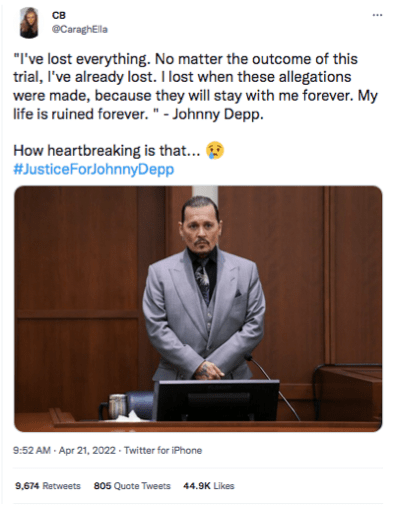
This tweet posted by @CaraghElla on April 21, 2022, currently has nearly 10 thousand retweets and nearly 45 thousand likes. The text is a quote from Depp speaking about the impact of the trial on his life, saying that his life has been “ruined forever” by Heard’s allegations. The Twitter user expresses sympathy for Depp, saying, “how heartbreaking is that…” followed by an Emoji of a crying face. The image accompanying the tweet shows Depp on his feet behind the witness stand, with his hands clasped together in front of him and a solemn expression on his face. The only hashtag used is #JusticeForJohnnyDepp.
Example #3
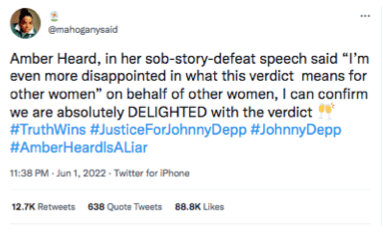
This tweet posted by @mahoganysaid on June 1, 2022, currently has nearly 13 thousand retweets and just shy of 89 thousand likes. The Twitter user expresses outright contempt for Heard, characterizing comments she made after the trial’s conclusion as a “sob story.” The tweet includes a quote from that statement, where Heard says that she is especially disappointed in the negative effects the verdict may have on other women. The quote is followed by the Twitter user stating, “on behalf of other women, I can confirm we are absolutely DELIGHTED with the verdict,” followed by an Emoji of two glasses being tapped together in a “cheers” motion. The hashtags used in addition to #JusticeForJohnnyDepp include #TruthWins, #JohnnyDepp, and #AmberHeardIsALiar. No images are included in the tweet.
Example #4

This tweet posted by @Rohankadam200 on February 2, 2020, currently has more than 5 thousand retweets and nearly 14 thousand likes. The body of the text includes the twitter user expressing thanks to Depp for his acting portrayal of “so many iconic, memorable, and amazing performances while suffering through abuse, torture, and being faced with so much hate and judgment.” Following the text, there is an image with four panels wherein four of Depp’s movie rolls are highlighted. The only hashtag included is #JusticeForJohnnyDepp.
Mental Models and Context Models: Teun van Dijk’s Theories
What can we learn about society from these examples? What is the social context in which these tweets – and the sentiments within them – are so widely circulated? Social contexts of this type of discourse can be understood by exploring the reciprocal relationship between mental models and context models. In the words of van Dijk (2009), “Subjective mental models of episodes account for the fact that people form their own personal representations of an event, with their own perspective, interests, evaluation, emotions, and other elements based on their unique personal history or their current subjective experience.” He goes on to explain:
“This is not only – pragmatically – true for the communicative situations in which people are ongoingly participating, but also – semantically – for the events they observe and talk about. This explains why people (e.g., journalists, witnesses in court) who participated in, or witnessed, the “same” event, each produce a different “version” of the event. In other words, models subjectively represent or construct situations, both those we talk about as well as those in which we talk.” (6).
So, it is clear that individual differences, and the biases that come with diverse backgrounds, influence how one might view an event. There are innumerable factors that influence an individual’s perception of an event, but large-sweeping examples include gender, age, race/ethnicity, socioeconomic status, and level of education. With this concept of subjective context models, we can begin to analyze the sociocultural context in which #JusticeForJohnnyDepp became such a highly circulated topic.
There are several discursive themes to be considered, on both macro and micro-levels. Even among such a small sample (in this case, only four tweets) the subjective context of the situation is dominated by certain overarching social themes. One such context model is the intermingling notions of truth, lies, and justice within both the American judicial system and the so-called court of public opinion. In the discourse of #JusticeForJohnnyDepp, there is an obvious implication that Depp himself has faced an injustice. In this context, there are two concurrent sub-categories given the allegations made by Heard: the first of the two is the social condemnation of domestic violence itself, and the second is the unacceptability of falsifying such accusations. The implications of the word “justice” are multi-faceted and nuanced, for the word has both legal and social outcomes. There is a legal, technical form of justice, wherein the jury commanded Heard to provide monetary compensation to Depp – but there is also a socially-derived form of justice wherein supporters of Depp believe that Heard should be punished in an equal reputational sense. While neither Depp nor Heard ever faced criminal charges, the discourse of #JusticeForJohnnyDepp has resulted in Heard herself becoming a social pariah.
It is also evident upon analysis of these tweets that a separate, but no less relevant social model has influenced discourse on Depp v. Heard: the culturally acceptable worship of celebrities, especially male actors who enjoy the status of “sex-symbol.” The fact that Depp’s career has been significantly longer and more well-known than Heard’s is reinforced by the public discourse surrounding his attractiveness. In examples #1 and #2, the images of Depp are candid, but flattering, whereas the most widely circulated photos of Heard portray her mid-speech or grimacing. However, in these tweets, pictures depicting Depp as handsome and well put together support the discourse that he is worthy of public sympathy, and more importantly, justice. Furthermore, in example #4, the images of Depp playing different roles throughout the years illustrate the ways in which his long and diverse career of playing beloved characters bolsters his public image. Depp himself has a reputation for being a “chameleon” of sorts, portraying a variety of roles that have, at times, challenged notions of mainstream masculinity. Fans of Depp seem to consider the identity of his characters to be intertwined with his true personality, which undoubtedly plays to his advantage.
Another important social context within the #JusticeForJohnnyDepp discourse is the evolving public conversation about gender roles in society. As discussed earlier in this study, the #MeToo movement provided a powerful discursive platform for celebrities and average people alike to discuss gender roles, power, and how gender roles influence power. In many ways, the Depp v. Heard case has challenged mainstream discourse that men are exclusively abusers and women are exclusively victims. Example #3 clearly displays the ways in which gender and feminism have influenced the #JusticeForJohnnyDepp discourse, by disparaging Heard’s concern for other women who are victims of domestic violence. In example #1, Depp is praised as heroic for speaking his “truth,” implying that previously, male victims of domestic violence were considered to be telling lies. Of course, this support for Depp’s “truth telling” is compounded by his celebrity status, and the aforementioned shift in discourse regarding power exchanges and gender roles.
Conclusion
The discourse surrounding Depp v. Heard continues to evolve, and it will undoubtedly continue to do so as society grapples with issues of power, gender, and justice. Social media has become an inextricable part of social communication, and a powerful vector of popular discourse, especially surrounding powerful and influential celebrities. As we have come to see, the discourse surrounding celebrities can provide insight into complex social norms. The hashtag #JusticeForJohnnyDepp clearly demonstrates the discursive power of the medium, and the ways in which social media both influences and is influenced by social discourse. Of course, there are methodological issues when it comes to studying discourse on social media, including the rising statistical influence of bots or fake accounts, as well as the sheer scale of such a huge and exponentially growing data set. Ultimately, this study has just barely scratched the surface of potential research into the discursive meaning of hashtags. The author has no doubt that there will be many peer-reviewed explorations of this nature in the future, especially when it comes to Depp v. Heard.
Works Cited
Couto, Sarah Do. “TikTok Creators Take Aim at Amber Heard with Degrading Memes amid Johnny Depp Trial – National.” Global News, Corus Entertainment Inc., 11 May 2022, https://globalnews.ca/news/8822873/amber-heard-johnny-depp-trial-memes-tik-tok/.
Fischer, Sara, and Neal Rothschild. “America More Interested in Depp-Heard Trial than Abortion.” Axios, Axios, 17 May 2022, https://web.archive.org/web/20220521003800/https://www.axios.com/2022/05/17/amber-h eard-johnny-depp-trial-social-media.
Hess, Amanda. “Tiktok’s Amber Heard Hate Machine.” The New York Times, The New York Times, 26 May 2022, https://www.nytimes.com/2022/05/26/arts/amber-heard-tiktok-johnny-depp.html.
Keating, Shannon. “Mainstream Feminism Has Failed US.” BuzzFeed News, BuzzFeed News, 2 June 2022, https://www.buzzfeednews.com/article/shannonkeating/abortion-rights-amber-heard-girlbo ss-feminism.
Levinson-King, Robin. “Depp-Heard Trial: Why Johnny Depp Lost in the UK but Won in the US.” BBC News, BBC, 2 June 2022, https://www.bbc.com/news/world-us-canada-61673676.
Madani, Doha, et al. “Johnny Depp Wins Defamation Suit against Amber Heard.” NBCNews.com, NBCUniversal News Group, 1 June 2022, https://www.nbcnews.com/pop-culture/pop-culture-news/johnny-depp-amber-heard-trial-ve rdict-rcna30926.
Partzsch, Lena. “The Power of Celebrities in Global Politics.” Celebrity Studies, vol. 6, no. 2, 12 Sept. 2014, pp. 178–191., https://doi.org/10.1080/19392397.2014.955120.
Rightler-McDaniels, Jodi L., and Elizabeth M. Hendrickson. “Hoes and Hashtags: Constructions of Gender and Race in Trending Topics.” Social Semiotics, vol. 24, no. 2, 2013, pp. 175–190., https://doi.org/10.1080/10350330.2013.859355.
Syal, Rajeev. “Why Did the Depp-Heard Libel Outcomes Differ in the US and UK?” The Guardian, Guardian News and Media, 2 June 2022, https://www.theguardian.com/law/2022/jun/02/johnny-depp-amber-heard-libel-outcomes-d iffer-us-uk.
Tait, Amelia. “’Amber Heard v Johnny Depp’ Has Turned into Trial by TikTok – and We’re All the Worse for It | Amelia Tait.” The Guardian, Guardian News and Media, 11 May
2022,
https://www.theguardian.com/commentisfree/2022/may/11/amber-heard-jonny-depp-trial-ti ktok-fans.
Tsioulcas, Anastasia, and Ayesha Rascoe. “On Social Media, Johnny Depp Is Winning Public Sympathy over Amber Heard.” NPR, NPR, 23 May 2022, https://www.npr.org/2022/05/23/1100685712/on-social-media-johnny-depp-is-winning-pub lic-sympathy-over-amber-heard.
Van Dijk, Teun Adrianus. Society and Discourse: How Social Contexts Influence Text and Talk. Cambridge University Press, 2009.
Wex Definitions Team. “Defamation.” Legal Information Institute, Cornell Law School, Mar. 2022, https://www.law.cornell.edu/wex/defamation.
Wilson, Josh. “Optics and Facts; What the Johnny Depp and Amber Heard Trial Teaches Us about the Power of Pr.” Forbes, Forbes Magazine, 18 May 2022, https://www.forbes.com/sites/joshwilson/2022/05/16/optics-and-facts-what-the-johnny-dep p-and-amber-heard-trial-teaches-us-about-the-power-of-pr/?sh=7281b274323e.
 Olivia Alphonsine Zivot
Leave a comment